Nature Communications Editors' Highlights Feature Chinese Scholar's Discovery of Novel Radio Bursts in the Solar Atmosphere
The research paper "Imaging spectroscopy reveals spike-like repeating radio burst pairs in the solar corona" by Dr. Suli Ma (from NSSC, CAS) and her international collaborators was selected as one of the 50 best recent papers in astronomy and planetary science by the editorial team.
The Editors' Highlights page is prominently displayed on the Nature Communications homepage (https://www.nature.com/ncomms/) and its dedicated subpage (https://www.nature.com/ncomms/editorshighlights).
The Research Discovery
Recently, an international team of astronomers, jointly composed of researchers from the National Space Science Center (NSSC) and National Astronomical Observatories(NAO) of the Chinese Academy of Sciences and the University of Glasgow (UK) announced an important research result: they have discovered a previously unknown form of radio emission in the solar atmosphere. This finding provides a new perspective for understanding how energy is released and transported in the corona.
Using the Low-Frequency Array (LOFAR) radio telescope, the researchers detected "spike-like repeating radio burst pairs" — paired brief flashes of radio energy, with a characteristic time delay of about 4 seconds between the two pulses.
The study reveals a new method for diagnosing turbulent plasma processes above the solar surface, offering a powerful tool for probing the magnetic field environment and particle acceleration in the Sun. Solar radio bursts are known to exhibit complex fine structures, but the newly discovered signals are particularly unique. Each event consists of two nearly identical narrowband radio spikes occurring at the same frequency: a bright, short "early" burst, followed about 4 seconds later by a weaker, delayed "echo-like" burst.
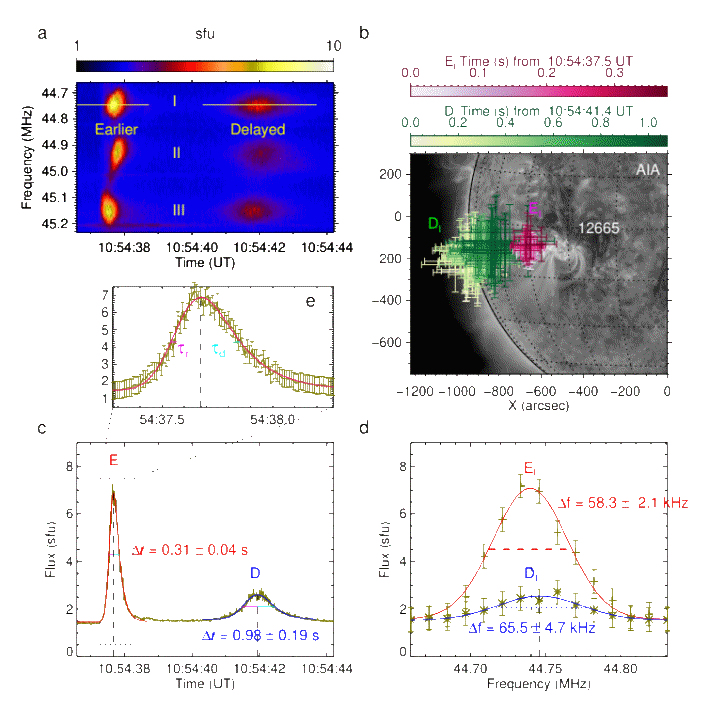
Figure 1. Dynamic spectrum, flux density, and source centroids of a repeating spike burst pair.
Solar radio bursts often show complex fine structures, but the newly discovered "spike-like burst pairs" are especially distinctive. Each event consists of two nearly identical narrowband radio spikes at the same frequency: a brief "earlier" burst (E), followed about 4 seconds later by a weaker, delayed "echo-like" burst (D). Figure 1 shows three spike burst pairs, with the early (E) and delayed "echo-like" (D) bursts. The centroids of the E source are concentrated near the negative-polarity core of the active region, while the centroids of the D source are systematically displaced by hundreds of arcseconds and appear more diffuse.
The team analyzed over 600 such burst pairs and found consistent patterns in timing, intensity, and spatial origin (Figure 2). By combining high-resolution spectroscopy with radio imaging, the team traced these bursts to an active region on the Sun. The key breakthrough came from the observation that the second burst in each pair originates from a different location in the corona — typically offset by hundreds of arcseconds. This spatial offset, together with weaker intensity and slower frequency drift, indicates that the delayed burst is not generated independently. Instead, it is most likely a scattered echo of the first burst, formed by radio waves being reflected and propagating through turbulent coronal plasma.
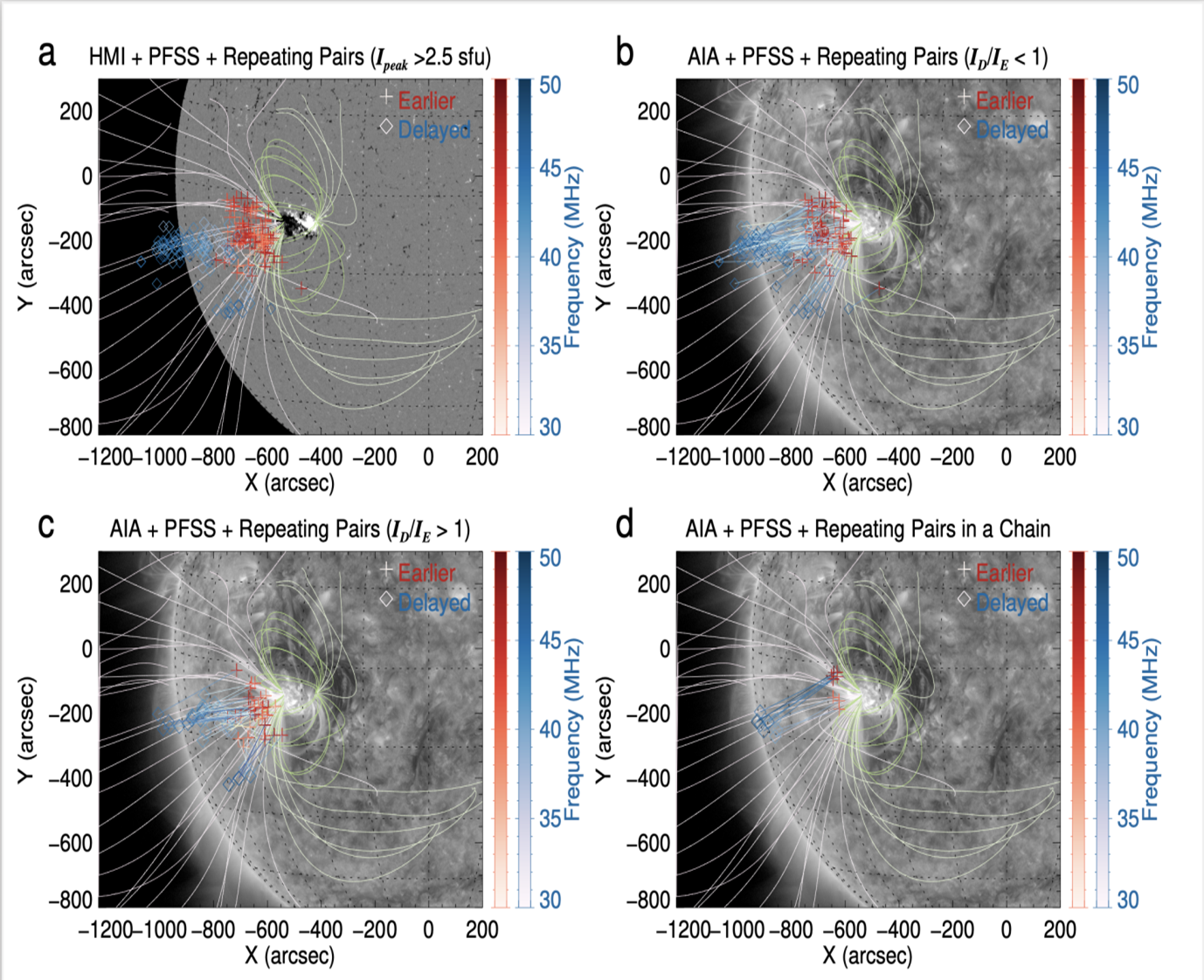
Figure 2. Centroid distribution of the repeating spike burst pairs.
To explain this phenomenon, the team performed numerical simulations of radio wave propagation in an anisotropic turbulent corona. The results are shown in Figure 3. For fundamental emission, the simulated echo delay is only about 1 second, and the source centroid of the reflected component remains co-spatial with the direct one, inconsistent with the observations. In contrast, for harmonic emission, the simulation produces a delay of about 4 seconds, with clearly separated centroids, in excellent agreement with the observations. Strong anisotropy (anisotropy parameter α ≈ 0.1) confines the emission to propagate along magnetic field lines, thereby explaining the observed directivity and the diffuse, displaced delayed source. The computer simulations support this interpretation, showing that radio waves can be redirected and delayed by anisotropic turbulence — density fluctuations aligned with the solar magnetic field. These conditions can produce echoes with precisely the observed time delays and spatial offsets.
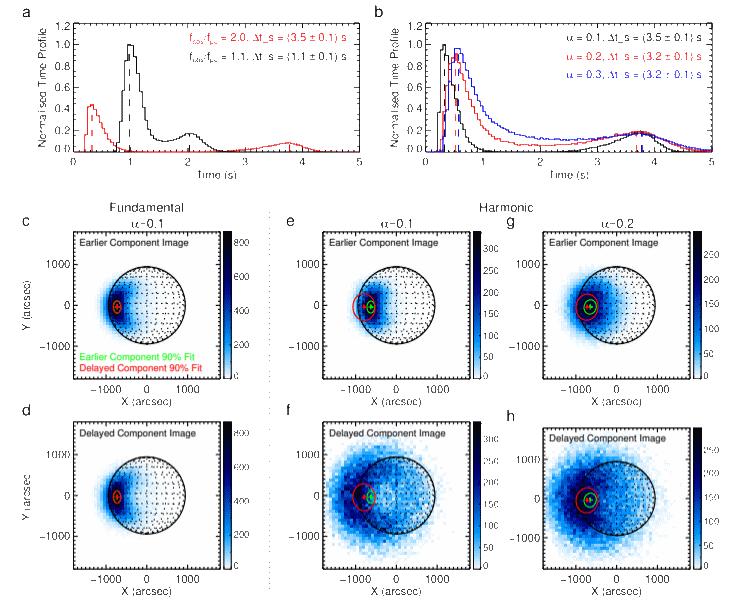
Figure 3. Numerical simulation results of radio wave propagation in an anisotropic turbulent corona.
Thus, as illustrated in Figure 4, each repeating burst pair is in fact a natural radio echo: the early component is the harmonic emission propagating directly outward; the delayed component is the echo of the same emission that first propagates downward, reflects off a plasma layer, and is then scattered upward to reach the observer.
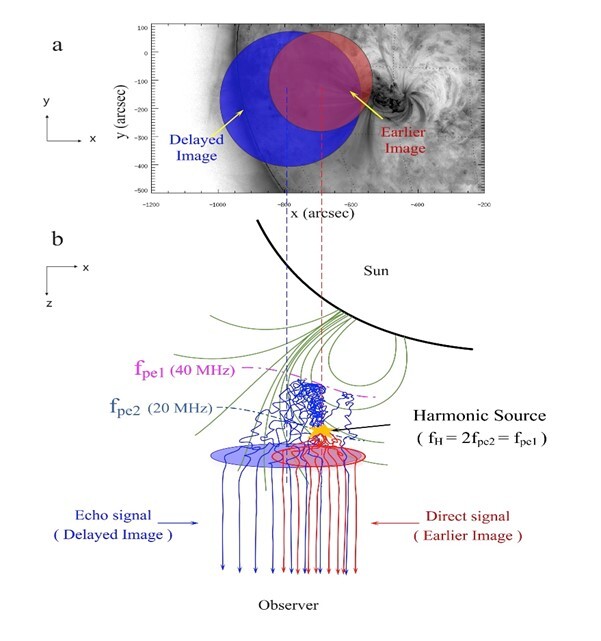
Figure 4. Schematic mechanism of the repeating spike burst pairs.
This study, for the first time, clearly identifies such fine structures as originating from harmonic plasma emission, resolving the long-standing fundamental/harmonic discrimination problem in solar radio observations. Moreover, the required anisotropy parameter α ≈ 0.1 confirms the strong anisotropic nature of coronal turbulence, and the natural echoes provide a measurement of the coronal density scale height (about R⊙/4 to R⊙/3). The bursts originate at altitudes of about one solar radius above the solar surface, much higher than typical flare emission regions. This implies that magnetic reconnection and electron acceleration — the main drivers of solar activity — may occur at previously unrecognised heights in the corona. These bursts are likely generated when electrons are accelerated in small-scale coronal reconnection events, which in turn excite plasma waves that produce the radio signals. The signals then propagate along multiple paths through the turbulent plasma, generating the delayed echo features.
This discovery has several important implications:
- New diagnostic for coronal turbulence: The timing and structure of the burst pairs provide a way to measure plasma density variations and turbulence.
- Insight into magnetic geometry: The directional scattering reveals how radio waves are guided along magnetic field lines.
- Clues to a long-standing mysteries: The same scattering process may explain why radar signals transmitted from Earth are weakly reflected by the Sun, offering a physical mechanism for the anomalously weak solar radar echoes observed over the past 50 years.
In just two hours of observation, more than a thousand such events were identified, indicating that these repeating burst pairs are a common but previously overlooked phenomenon. These signals provide a new avenue for studying the release, transport, and conversion of energy in the Sun's outer atmosphere. The discovery of repeating burst pairs also opens a new window for exploring coronal plasma turbulence and particle acceleration. Future observations hold great potential for revealing the complexity of the solar corona.
Based on the recent paper: Suli Ma, Eduard P. Kontar, Daniel L. Clarkson, Huadong Chen & Yihua Yan, Imaging spectroscopy reveals spike-like repeating radio burst pairs in the solar corona. Nat Commun 17, 5131 (2026). https://doi.org/10.1038/s41467-026-74137-2
The first and corresponding author of the paper is Associate Professor Suli Ma from the Key Laboratory of Solar Activity and Space Weather, National Space Science Center, Chinese Academy of Sciences. The co-corresponding author is Professor Eduard Kontar from the University of Glasgow. Key collaborators include Professor Yihua Yan (NSSC), Dr. Daniel Clarkson (University of Glasgow), and Associate Professor Donghua Chen (National Astronomical Observatories, CAS).