Researchers from NSSC Reveal Enhanced Polar Stratospheric Downward Transport during Solar Proton Events Using Ozone Tracer Technique
The Brewer-Dobson circulation (BDC) drives upward transport of air in the tropics and downward transport over the polar regions, governing the global distribution of ozone and water vapor, and serves as the key process of stratospheric mass transport. However, the downwelling in the polar stratosphere is extremely slow, making direct measurement exceedingly difficult. Solar proton events (SPEs), as the most energetic particle precipitation process, can trigger catalytic ozone destruction upon entering the atmosphere. Under polar night conditions, the photochemical lifetime of ozone extends to several months, allowing ozone depletion signatures to serve as an ideal tracer of atmospheric dynamical processes.
In previous work, Researcher Hui Li and Ph.D. student Yaxuan Li, affiliated with Professor Chi Wang’s group from the State Key Laboratory of Solar Activity and Space Weather, National Space Science Center, Chinese Academy of Sciences, systematically revealed the enhancement effect of SPEs on the Arctic stratospheric polar vortex. They quantitatively characterized the altitudinal distribution of polar vortex wind speed increases and confirmed a positive correlation between solar energetic proton flux and polar vortex intensification. However, how SPEs modulate the downwelling branch of the BDC, whether the downwelling rate can be directly quantified, and how the background climatological state regulates this process have remained unresolved.
To address these questions, Researcher Hui Li and Ph.D. student Yuting Wang, together with their colleagues, innovatively proposed an “ozone tracer” method. This approach uses ozone depletion trajectories to mark descending air masses, effectively turning SPEs into a natural experiment for studying stratospheric dynamics. Using the ozone depletion layer during SPEs as a tracer, they identified continuously descending depletion trajectories from polar winter ozone data (2004–2023) acquired by the MLS instrument aboard the Aura satellite, and performed linear fits to directly obtain stratospheric downwelling velocities. From 36 SPEs, they selected 21 high-quality events and achieved three key findings:
2. Downwelling velocity is significantly positively correlated with SPE intensity. The correlation coefficient between downwelling velocity and the time-integrated proton flux (>10 MeV) reached 0.54 (p = 0.01), and the result remained robust in sensitivity tests.
This study directly quantifies polar stratospheric downwelling rates during SPEs using ozone tracing. It demonstrates that solar energetic particles not only destroy ozone via chemical pathways but also modulate the downwelling branch of stratospheric circulation by altering planetary wave dynamics, deepening our understanding of how space weather affects Earth’s middle atmosphere. The findings have been published in the international journal Geophysical Research Letters.
Article: Wang, Y., Li, H., Li, Y., Pan, Y., Xu, W., Ni, B., & Wang, C. (2026). Solar proton events enhance polar upper stratospheric downward transport: Evidence from ozone-traced descent. Geophysical Research Letters, 53, https://doi.org/10.1029/2025GL120368.
Related Research: Li, H., Li, Y., Wang, Y., Sun, J., & Wang, C. (2025). Impact of solar proton events on the stratospheric polar vortex in the Northern Hemisphere: A quantitative analysis. Journal of Geophysical Research: Space Physics, 130, https://doi.org/10.1029/2024JA033068
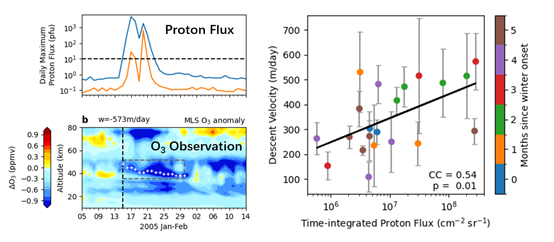
Figure. Polar stratospheric downwelling velocities during SPEs retrieved by the ozone tracer method (left);
significant positive correlation between descent velocity and SPE intensity (right).